As part of our transition from England to Arizona as I begin my new role of Academic Dean at Prescott College, I was fortunate to spend some time on trails around Prescott earlier this month, taking some tentative steps in these new mountains of home – up into the deeper snow atop Granite Mountain and along the switchbacks up the side of Thumb Butte just west of town — and farther afield to the Colorado River nestled deep in the February shadows of the Grand Canyon.

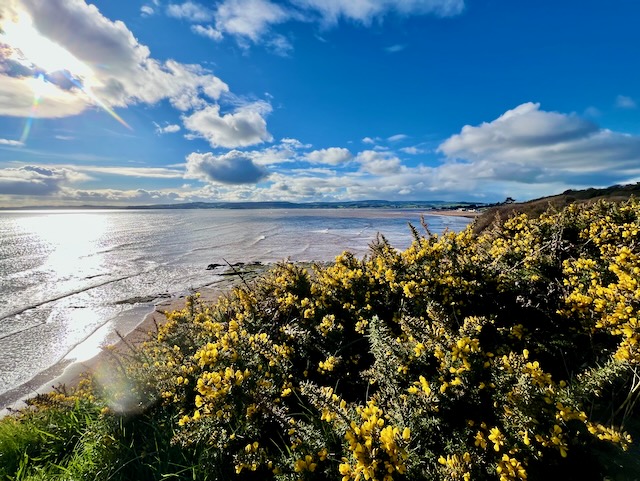
The landscape and climate around Prescott could hardly be more different from our home in the southwest of England, where we are only now emerging from a mild and wet winter, with the River Exe washing over our riverside path nearly every day in the past fortnight. Although I describe Arizona as being ‘nearly the opposite’ of my beloved landscapes from Dartmoor to Cornwall to southern Wales, there is a shared openness in the undulations of this leavened land — here punctuated year-round by brilliant yellow plashes of prickly gorse, there of prickly pear — where I can become lost enough to find myself in ways that nourish head, heart and hands.
Thomas Merton tells us, ‘action is the stream, and contemplation is the spring’. We each have our entry to moments and places that balance contemplation and action, and over the past four years, Dartmoor has been mine — often finding me ankle-deep in bogs that coalesce to headwaters of one of the more than two dozen rivers that rise high on the moor. It’s hard to relinquish a place that so quickly so deeply permeated my skin and muscle and bone — but having been to nearly every corner of Dartmoor, the headwaters of many river, and well more than two hundred tors, I’m ready to trade these brilliant waterlogged greens for whatever comes next.

In the hills to the west of Prescott ten days ago, my pace slowed and my breathing and heart rate climbed as I tried to get used to the elevation on the switchbacks above Blair Pass (around 2000 metres), passages from books I’d read years before slowly started to seep in at the edges of my senses. Anne Zwinger, Leslie Marmon Silko, Mary Austin, Colin Fletcher, Gloria Anzaldúa, Gretel Ehrlich, Terry Tempest Williams, and so many more. The place and pace opened my literary memory the way a hint of a smell can so readily transport us back to childhood. The largely open chaparral landscape with a few fire-scarred pinion pine here was drawing me both upward and into myself.
Terry Tempest Williams’ triptych, The Open Space of Democracy, has, with Gretel Erlich’s Solace of Open Spaces, long been a touchstone for my engagement with changing ecologies and the human communities that make their home within them. Williams’ opening essay, ‘Commencement,’ is a transcription of her graduation address at the University of Utah in 2003. With the shadow of September 11, 2001 then an inconceivably heavy weight upon so many, she asks ‘What does the open space of democracy look like?’ and offers,
‘In the open space of democracy, the health of the environment is seen as the wealth of our communities.
In the open space of democracy, beauty is not optional, but essential to our survival as a species. And technology is not rendered at the expense of life, but developed out of a reverence for life.
The open space of democracy is a landscape that encourages diversity and discourages conformity.
Democracy can also be messy and chaotic. It requires patience and persistence.
Democracy is an insecure landscape.’
Landscapes are always in flux, adaptable, and resilient, and unreservedly open to the world, as democracies must also be. Although I often find the solace of inner spaces seductive — the close focus, isolation and quiet a welcome respite from a fraught world, I’ve found more recently that letting go is also core to building resilience and can open to a sweeping outward spiral from contemplation to action — from spring to stream to sea — and invite a confluence of worlds to deeply enrich my own.
In recent years and with increasing urgency, I’ve taken these embodied moments, where inner and outer ecologies interweave, to build a framework for a similar adaptability and openness in learning, where practice-led, ecologically-focused and community-grounded learning serve as the foundation of education that is regenerative, democratic, accessible, distributed and deinstitutionalised. As Benjamin Freud has recently and succinctly put it, at its core, ‘Regeneration is about becoming with the world, it is about understanding that we are not separate from the world, entangled with every particle in the universe’. There are rich stories of regeneration everywhere to guide us; perhaps we just need to (re)learn how to listen to them.
Along her journey from Wyoming snowfields to the confluence with the Colorado, Ann Zwinger writes the layered ecologies and histories of the Green River into herself, seeing its meandering like lizard prints ‘calligraph the sand, precise patterns laid in loose, open arcs’. Even in the depths of the Desolation Canyon, openness prevails in each meandering arc and blossoms into invitation — to place, to self, to history, to time. Upstream from Zwinger, Gretel Ehrlich finds in the hardscrabble wind-swept beauty of Wyoming’s ranch country, ‘Everything in nature invites us constantly to be what we are. We are often like rivers: careless and forceful, timid and dangerous, lucid and muddied, eddying, gleaming, still’.
In my soon-to-be-published chapter in One Day in 2050: Clima Utopyas, I point toward an aspirational future, where systems and networks have opened across difference, and ‘The narrative of ‘I’ had yielded to the symphony of ‘we’, an all-encompassing paean of life sharing our radiant globe. ‘Ecology’ had faded, supplanted by ‘unity’, ‘harmony’, ‘symbiosis’ . . . [and] humans were no longer mere observers but engaged participants, active choreographers in the always emergent dance of life, finally at home.’
As I step into this new chapter of ground truthing, commencement and engagement, rather than drawing a recursive, circular path, I am more than ever part of an outward-unfurling spiral, with open heart, open arms and open mind.

Here are your waters and your watering place.
Drink and be whole again beyond confusion.
Robert Frost, Directive
 Regenerative Learning Network
One response to “A Confluence of Learning: Ecology, Democracy, and Education”
[…] Speaking with students over washing up that same evening, many of the Josei learning community were already articulating future career pathways in permaculture and regenerative food and farming practices, equally inspired by their site visits and forest garden initiative, as by conversations with older communities around embedding crop rotation and seasonal sowing techniques. Walking home with belly full, and with thoughts of my following week’s journey to Niigata University as part of their work with Sado Island Centre for Ecological Sustainability, identifying regenerative education initiatives for school leavers, focused on stimulating new carers in fisheries and farming on the island. My attention turns to the deep relational practice that I have witnessed sitting around the dinner table and listening to teenagers in close and compassionate conversation. What might happen, I wonder, if we allowed more adolescent learners to evolve their own governance, living and learning in close proximity, and having agency over their daily rhythms and interests. What kind of convivial and collaborative initiatives might further emerge, to reflect on my collaborator and colleague Pavel Cenkl’s own thoughts, how might Higher Education offer further bridges as well as subject pathways ‘where practice-led, ecologically-focused and community-grounded learning serve as the foundation of education that is regenerative, democratic, accessible, distributed and deinstitutionalised.’ (https://regenlearning.org/2024/02/26/a-confluence-of-learning/) […]
LikeLike