Rachel Sweeney
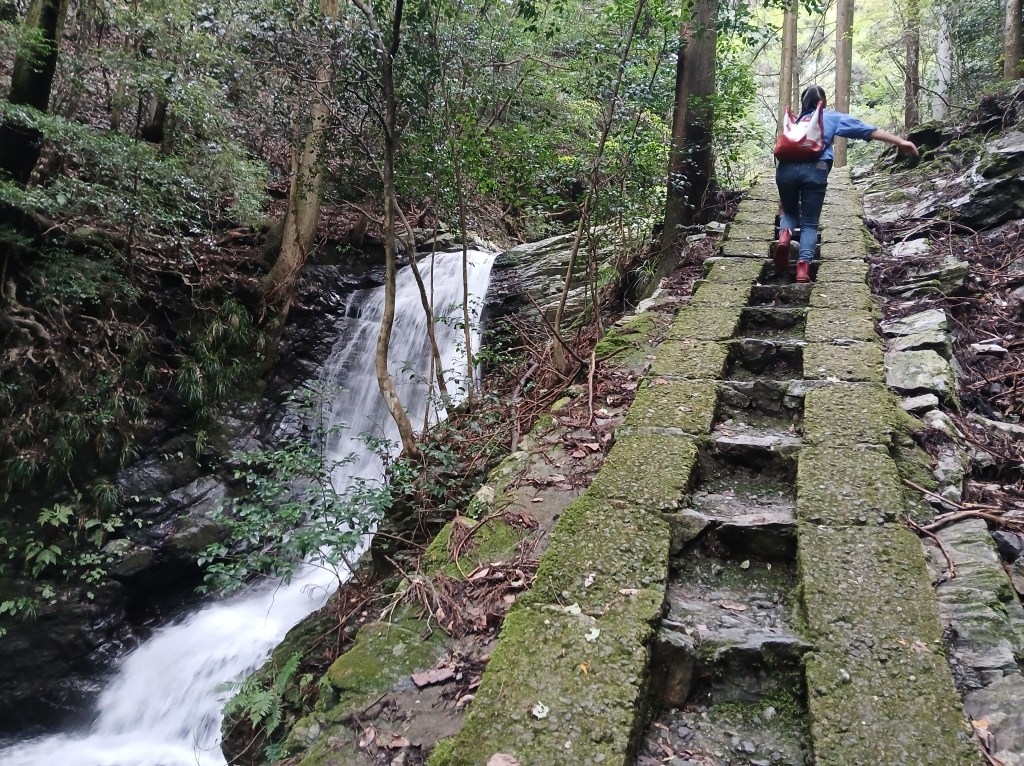
My Japan travels start in Kamiyama Village, approximately 3 hours south of Osaka on Shikoku Island, where mornings are spent integrating high altitude walks with late seasonal dips in extraordinarily crystal clean rivers (trying to avert the local forest servicemen from calling the emergency services to ‘rescue’ the crazy foreigner from arctic conditions, which, incidentally, are more akin to domestic bath temperatures for a native Irish wild swimmer!). My arrival here marks the start of a seven-week tour of Japan and China, seeking out educational models of resilient and regenerative futures education which align my own interests of both sociotechnical and embodied collective learning, which operate out of formal institutions, designed through immersive learning platforms that bridge classroom and community.
Having spent my last three years leading on a Master’s program in Movement Mind and Ecology at Schumacher College, a leading transformative educational community, whose Masters programs are founded on interdisciplinary and holistic education, my own postgraduate teaching design has always prioritised ways to engage place and people directly through action based research and through participatory practice. Students on this program have forged essential links with communities of practice in the Devon region, articulated around projects engaging in water heritage on the local river Dart, Dartmoor folk traditions, eco pedagogies for local forest schools and ecological wellbeing initiatives for regional health services. Designed to promote eco civic action through bodily engagement, the program’s fourth module ‘Performing Place’ encourages students to formalise working projects with external partners and environmental stakeholders through the deployment of a community-facing project. Research engagement and facilitation methods draw from a range of embodied activist approaches, many of which underpin students’ own learning experiences, and are directed in this penultimate module outwardly, exercised through artistic and ecological thinking around social justice. These community facing projects – designed, delivered and critically evaluated by each individual Master’s student – serve as a way to deepen an understanding of complex organisations, ecosystems and/or social infrastructures, through evaluating a range of quantitative and qualitative, theoretical and experiential methods of engaging directly with external partners.
Located deep in the mountains of Tokoshima prefecture, Kamiyama village is a leading example of creative depopulation, supported through the rural community Green Valley initiative, whose “work in residence” program was established to encourage urban based companies to set up satellite offices, and which is additionally formed on the strengths of the long standing and internationally established KAIR artist residency program. Running since 1999, this artist scheme has attracted leading contemporary visual arts makers to the region to work for up to three months, creating land-based material arts practices that respond to the natural environment, and that are developed in close proximity to the local community, often unearthing ecological themes around biodiversity and sustainable land renewal approaches.
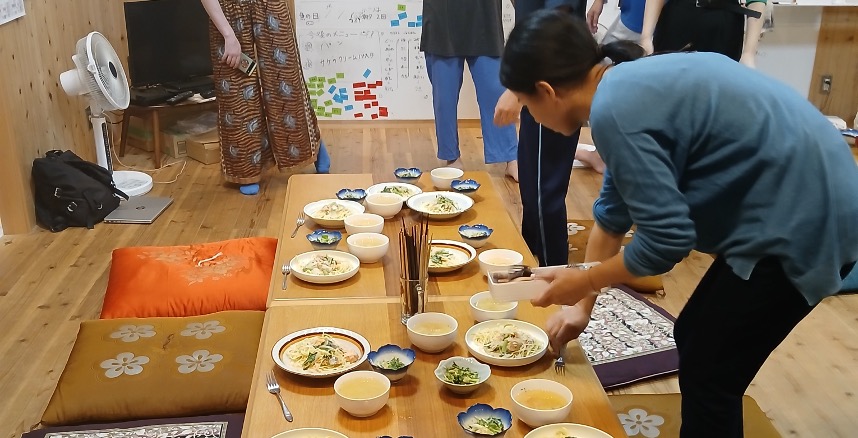
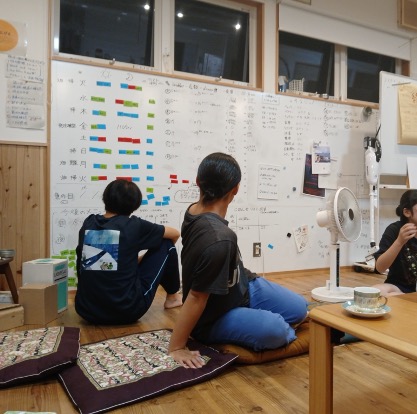
Josei High School Kamiyama residents
My new ‘adopted’ office here is the architect award winning Onoji communal space which supports a generous library, multiple hot desks, a breakout children’s playroom and an open teaching space, and which sits a nestled next to the Akui river, within a small collective of eco designed wooden houses – all of which serve as an excellent example of Green Valley creative depopulation residential initiatives, offering low cost family housing alongside community facilities.
Surrounded by inspiring examples of economic resilience through small scale hospitality enterprise projects such as Kamiyama Beer, and Kamaya Food Hub, one of the highlights of my first week here is visiting the highly progressive Josei Kamiyama High School, where the hands, head and heart approach to learning is very much akin to Schumacher College’s own educational ethos, though adapted for younger learners. Here, students of between 15-17 years old live in shared housing of up to twenty residents, where they maintain their own governance, deciding autonomously on cooking and cleaning duties, generating weekly menu’s and organising food budgets, as well as implementing shared cooking, cleaning and gardening rotas. Apart from their daily formal studies, the students are engaged in a diverse array of regenerative agriculture projects, working with cross generational approaches, such as learning traditional indigo dyeing, as well as experimenting with new permaculture techniques, tending to a 5x acre patch of reclaimed forestland (the main challenge here being postwar reforestation and the overpopulation of fast yield cedar trees and their environmental concerns).
The educational ethos here supports a robust counter narrative to many of the challenges currently facing secondary schools, where a lack of retention and social isolation/withdrawal are common features affecting young learners. The recent opening of Hikikomori Research Lab at Kyuku University reflects the very real challenges facing over 65% of the adolescent population in Japan currently, many of whom chose to completely withdraw from any social activity, limiting their engagement with their studies to online only access. Certainly, recorded figures are on the rise post-pandemic although, while the global health crisis may have engendered new and progressive sociotechnical learning platforms, equally however, the overreliance of screen-based learning can be seen as perpetuating already troubling responses to our economic crisis, through further endorsing a fundamental lack of social mobility and community wellbeing.

As Takahiro Kato, a Lecturer in the Department of Psychiatry and Neurology at Kyushu University Hospital suggests, this condition not only affects young people, but also is a result of a loss of identity for employees undergoing the radical shift from corporate working responsibilities, where “(f)or the “baby boomer” generation, born after the war, who got married during the high economic growth of the 1960s and 1970s, and who had devoted themselves for many years to the ever-growing companies as hard-working employees, the collapse of the corporate myth led to a loss of refuge for them, and it was also during this period that suicides among middle-aged and elderly people increased sharply.” (https://www.data-max.co.jp/article/21378?rct=health)
One contemporary Japanese artist focusing on this taboo subject in his work currently is Watanabe Atsushi. Through extending his artistic work to include the experiences of young Japanese people from the wider population who may not have directly encountered psychiatric services, or whose experiences remain undisclosed, Watanabe’s work can be regarded as cultivating “practices of resistance” through illustrating the deep value of responding outside of mental health institutions to the embodied experiences of those suffering in silence. Having experienced extreme Hikikomori, living behind closed doors for almost three years of deep isolation, Watanabe’s hard hitting live performance work offers a vital insight into those sociological conditions facing young learners that are arguably exacerbated by systemic injustices and educational challenges facing us in this time of polycrisis.
Located further up river and offering practical workshops in woodworking, digital programming, sewing and handicraft, the Kamiyama Maker Space was established in 2016 to actively seek out new ways of encouraging the creative use of technology through more haptic and experiential modalities for young learners. Here, leading international artists such as Rufus Ward and Sayaka Abe, now embedded in the village, have brought with them graphic design techniques and radical arts pedagogies to foster ideas for creative workshops for local secondary and elementary schools, encouraging students to interact and explore embodied techniques to produce digital content and to empowering young participants through immersive innovation and hands on learning. Conversely, I am aware of the diverse educational eco-system that such a small scale community such as Kamiyama offers, reflected not only in the contrasting perspectives of the two main secondary schools, where Josei’s own educational ethos differs quite radically to the recently opened neighbouring Kamiyama Marugoto College of Design, Technology, and Entrepreneurship, an ambitious learning community where each individual student is supported through full scholarships, and whose values are fostered in nurturing digital entrepreneurship.
Digesting my impressive three course meal, prepared by the young Josei High School residents, before offering an evening of ‘dance skills exchange’ (my slightly rusty Irish choreography traded for Tokoshima’s world renowned traditional Awa Odori ‘fan dance’ moves) – I reflect on how such diverse and thriving learning communities equally inspire both confidence and community participatory values in the student, yet I wonder whether we have yet to identify new pathways for Hands Head and Heart learning that might further interact through digital creative storytelling, as much as through hands on learning, to encompass the three pillars of regenerative education (through self-care, people-care and earth-care), as articulated the UK’s leading ThoughtBox Education holistic framework.
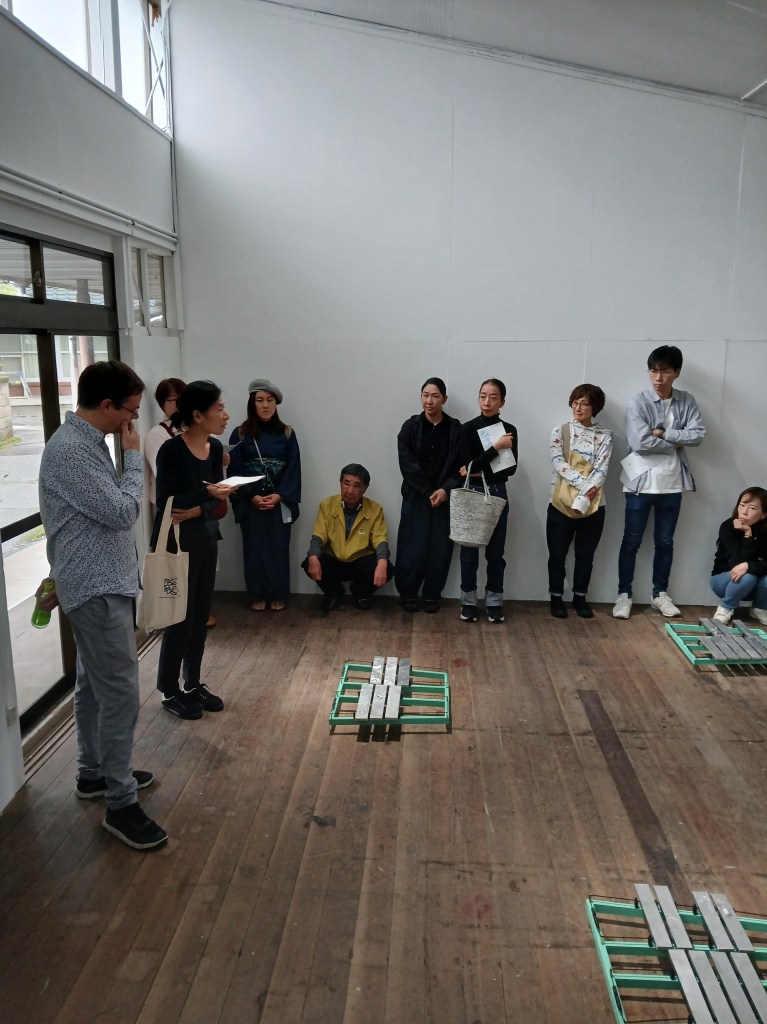
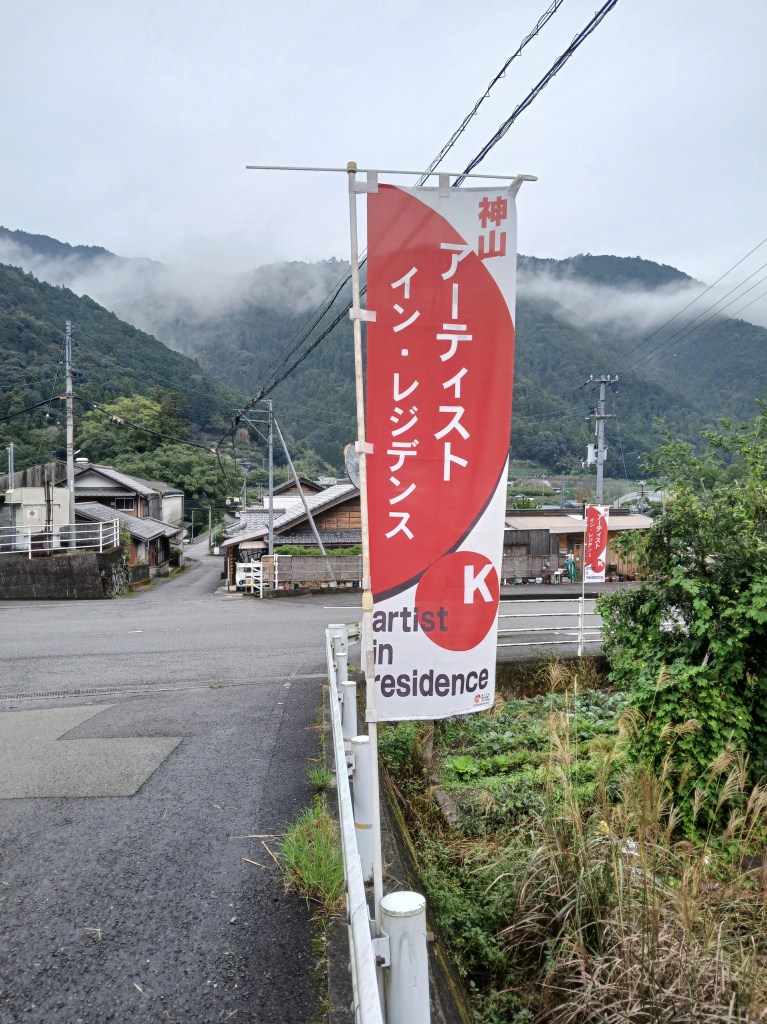
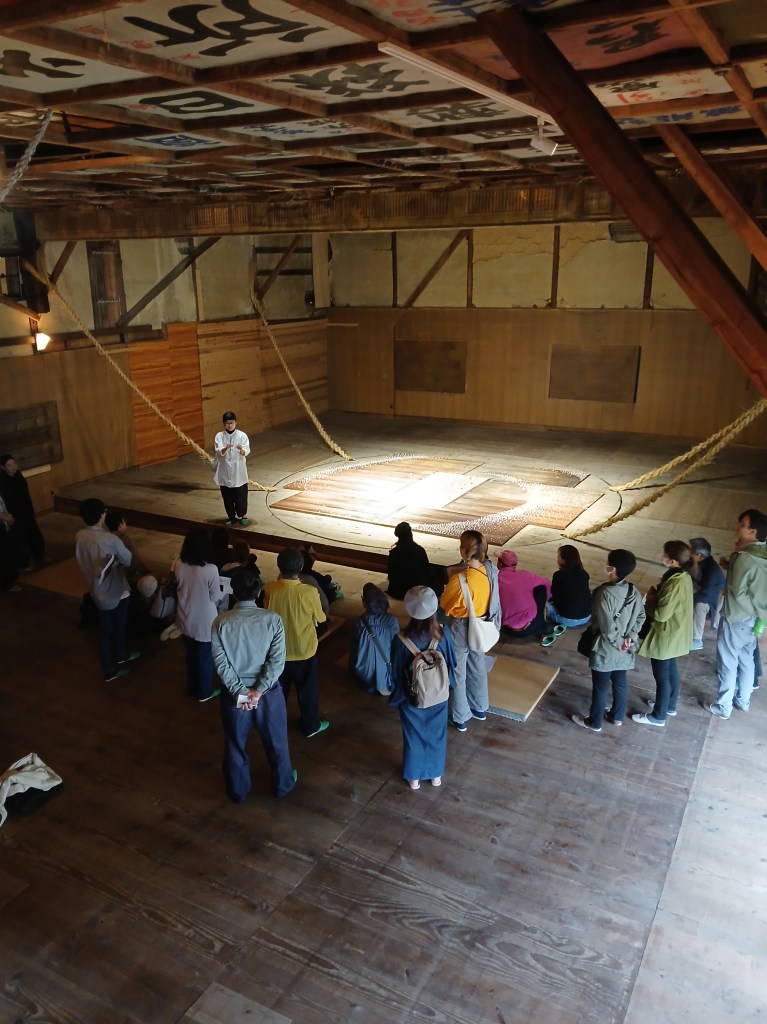
KAIR artist in residence opening 2024, Julien Groosman (left) and Yukari Kaihori (right)
Speaking with students over washing up that same evening, many of the Josei learning community were already articulating future career pathways in permaculture and regenerative food and farming practices, equally inspired by their site visits and forest garden initiative, as by conversations with older communities around embedding crop rotation and seasonal sowing techniques. Walking home with belly full, my thoughts turn toward my following week’s journey to Niigata University, to contribute to a five year research initiative focuse don rural regenerative education, through the Sado Island Centre for Ecological Sustainability, to help to foster new education initiatives for early school leavers, focused on stimulating new careers in fisheries and farming.
My attention turns to the deep relational practice that I have witnessed sitting around the dinner table and listening to teenagers in close and compassionate conversation. What might happen, I wonder, if we allowed more adolescent learners to evolve their own governance, living and learning in close proximity, and having agency over their daily rhythms and interests. What kind of convivial and collaborative initiatives might further emerge, to support new directives, as echoed in my learning colleague Pavel Cenkl own thoughts; how might Higher Education offer further bridges as well as subject pathways ‘where practice-led, ecologically-focused and community-grounded learning serve as the foundation of education that is regenerative, democratic, accessible, distributed and deinstitutionalised.’ (https://regenlearning.org/2024/02/26/a-confluence-of-learning/)
 Regenerative Learning Network